Isabela
Shaped like a sea horse, Isabela is the largest of the the islands in the
Galapagos, more than 4 times larger than Santa Cruz the next largest.
Isabela is 80 miles (100 km) in length and though it is remarkably beautiful it
is not one of the most visited islands in the chain. Its visitor sites are
far apart making them accessible only to faster boats or those with longer
itineraries.
One of the youngest islands, Isabela is located on the western edge of the
archipelago near the Galapagos Hot Spot. At approximately 1 million years
old, the island was formed by the merger of 6 shield volcanoes - Alcedo, Cerro
Azul, Darwin, Ecuador, Sierra Negra and Wolf. All of these volcanoes
except Ecuador are still active making it one of the most volcanically active
places on earth. Visitors cruising past Elizabeth Bay on the west coast
can see evidence of this activity in the fumaroles rising from Volcan Chico on
Sierra Negra.
Two of the volcanoes Ecuador and Volcan Wolf lie directly on the
Ecuador.
Volcan Wolf is the youngest of Isabela's volcanoes and at 5,600
ft (1707 m) the highest point in the Galapagos. Isabela is known for its geology, providing visitors with excellent examples
of the geologic occurrences that have created the Galapagos Islands including
uplifts at Urvina Bay and the Bolivar Channel, Tuft cones at Tagus Cove, and
Pulmace on Alcedo.
Isabela is also interesting for its flora and fauna. The young island
does not follow the vegetation zones of the other islands. The relatively
new lava fields and surrounding soils have not developed the sufficient
nutrients required to support the varied life zones found on other
islands. Another obvious difference occurs on Volcan Wolf and Cerro Azul,
these volcanoes loft above the cloud cover and are arid on top.
Isabela's rich animal, bird, and marine life is beyond compare. Isabela
is home to more wild tortoises than all the other islands. Isabela's large
size and notable topography created barriers for the slow moving tortoises;
apparently the creatures were unable to cross lava flows and other obstacles,
causing several different sub-species of tortoise to develop. Today
tortoises roam free in the calderas of Alcedo, Wolf, Cerro Azul, Darwin and
Sierra Negra.
Alcedo Tortoises spend most of their life wallowing in the mud at the
volcano crater. The mud offers moisture, insulation and protects
their exposed flesh from mosquitoes, ticks and other insects. The
giant tortoises have a mediocre heat control system requiring them to
seek the coolness of the mud during the heat of the day and the extra
insulation during the cool of the night.
When tortoises reach 20 to 25 years of age they become sexually
active. Beginning approximately a month before the end of the
rainy season the tortoises mate, after mating the females set out on a
journey to lay their eggs. Alcedo Females venture down to
the sandy shores of Urvina Bay building nests in the sand. The
female digs a hole with its hind legs approximately (30cm) deep.
Once she is please with the hole she deposits between 2 and 16 eggs then
covers them with a layer of mud and urine before starting her journey
back up the mountain. Baby tortoise take between 120 - 140 days to
hatch usually happening between December and April.
On the west coast of Isabela the nutrient rich Cromwell Current upwelling creating a feeding ground for fish, whales, dolphin and
birds. These waters have long been known as the best place to see
whales in the Galapagos. Some 16 species of whales have been
identified in the area including humpbacks, sperms, Sei, Minkes and
Orcas. During the 19th century whalers hunted in these waters
until the giant creatures were near extinction. The steep cliffs
of Tagus Cove bare the names of many of the whaling ships, which hunted
in these waters.
Birders will be delighted with the offerings of Isabela.
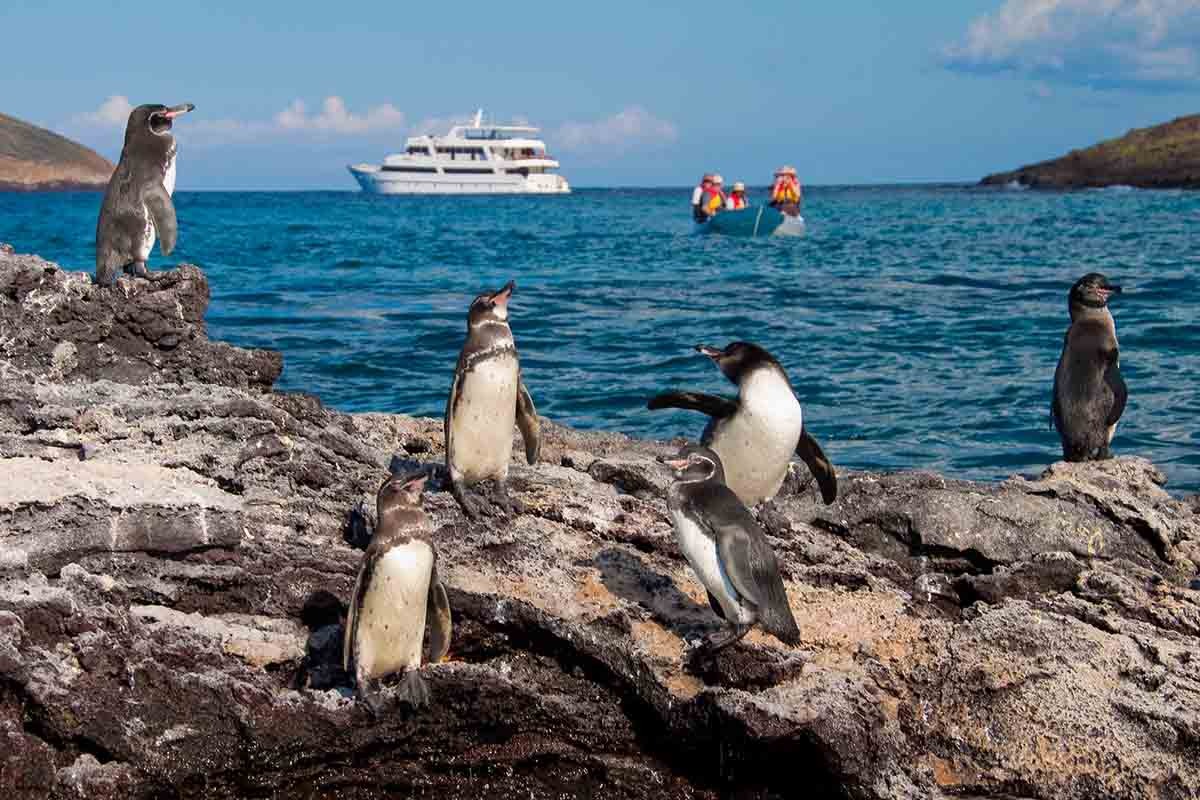
Galapagos Penguins and Flightless Cormorants also feed from the Cromwell
Current upwelling. These endemic birds nest along the coast of
Isabela and neighboring Fernandina. The Mangrove Finch, Galapagos
Hawk, Brown Pelican, Pink Flamingo and Blue Heron are among the birds
who make their home on Isabela.
Staying on Isabela
Located on the southeastern coast of Isabela. Puerto Villamil is the main settlement
areas on Isabela. A small peaceful town with a laid back atmosphere offers
quite a different experience than the tourist shops on
Puerto
Ayora.
Villamil and the neighboring settlement of
Santo Tomas were founded in 1897 by Antonio Gil. Villamil began as the center of a
lime production operation. The lime produced by burning coral found off Isabela.
Santo Tomas served as a sulfur mine and coffee plantation. The ventures were only
somewhat profitable due to water limitations.
Together Villamil and Santo Tomas now have a population of approximately 1000
people. There are a variety of rooms available for visitors and
equipment and supplies available for those climbing the near by Sierra Negra Volcano.
Villamil is often considered the most beautiful site in the Galapagos with
its long white sand, palm lined beaches. Behind Villamil are several
brackish water lagoons where Pink Flamingoes, Common Stilts, Whimbrels,
White-Cheeked Pintails, Gallinules are usually seen. The lagoons are nesting areas
between November - April. The beaches and
lagoons near Villamil are home to the best migratory bird viewing in the Galapagos.
Villamil is also home to the Darwin Center's tortoise breeding center on
Isabela.
Villamil is considered the most
beautiful spot in the islands, this small town with a relaxed attitude
is Isabela's main town. Visitors can enjoy the beauty of Isabela
at one of the small hotels available here.
Visits on Isabela
Elizabeth Bay
Located on the west coast of Isabela, at the Perry Isthmus, Elizabeth Bay is
a marine visitor site (no landings are permitted). As you visit
Elizabeth bay panga Galapagos Hawks soar overhear and schools of Pompanos and Dorados can be seen swimming underneath
you. Your panga brings you to Las Marielas the small islets just outside the bay
and home to the largest concentration of
Galapagos Penguins
living in
the islands. This is one of the island's
breeding site for Penguins. The ride continues into a
red mangrove cove.
The panga passes through the red root and green leaf breeding ground for fish
and Sea Turtles.
Brown Pelicans, Flightless
Cormorants, Spotted Eagle Rays, Golden Rays and
Sea
Lions are often seen.
|
|
|

Tagus Cove
Lying directly east of Fernandina on the west coast approximately 2/3's of
the way up Isabela is the narrow channel of Tagus Cove. Arriving here
the boat will sail through the Bolivar Channel, these are the
coldest most productive waters in the Galapagos, the upwelling
of the Cronwell Current, where dolphins and whales are
frequently seen. Tagus Cove, named for the British naval
vessel that moored here in 1814, was used historically as an
anchorage for pirates and whalers. One can still find the
names of the ships carved into the rock above the landing (a
practice now prohibited). The coves quiet waters make for an
ideal panga ride beneath its sheltered cliffs, where blue-fitted
boobies, brown noddies, pelicans and noddy terns make their
nests, and flightless cormorants and penguins inhabit the lava
ledges.
From the shore, a wooden stairway rises to the dusty trail passing through the
Paleo Santo
Forests
to reach the perfectly round saltwater crater, Darwin Lake. Continuing
on the trail around the lake through a dry vegetation zone, and then climbs
inland to a promontory formed by spatter cones. The site provides
spectacular views back towards the anchorage in the bay, as well as Darwin
Volcano and Wolf Volcano farther north.
Urbina Bay
Lying at the foot of
Alcedo
Volcano, south of Tagus
Cove, is Urvina Bay (Urbina Bay) one of the best and the most recent
example of Geological Uplift in the Galapagos. Uplift occurs when
the molten materials beneath the surface shifts. In 1954 the
shoreline was uplifted nearly 15 feet (4 meters). The coastline was
driven 3/4 of a mile further out to sea, exposing giant coral heads and
stranding marine organisms on what was now on shore. A Disney film
crew visited the site shortly afterwards and discovered skeletons of
sharks,
sea turtles and lobsters unable to find the ocean from the
rapidly rising land. Schools of fish were found stranded in newly formed
tide pools. Boulder sized coral heads can be seen near the area that
once was the beach. The uplifting of Urvina Bay was followed by an
eruption of Alcedo a few weeks later.
Seasonally Urvina Bay provides a nesting area for many of the Galapagos
creatures. Female
tortoises journey down from Alcedo to lay their eggs in
the sand.
Galapagos
Penguins, Flightless Cormorants and Brown Pelicans nest in
the area as well.
The visit begins with a wet landing on the white sand beach. Difficulty
of the route varies by season. The trail ranges from stark and easily
passable during the dry season to mildly challenging requiring wading to pass
during the rainy season. Visitors cross the uplifted region learning about this
geological wonder. Then reach the sandy area that was once the
beach. Shorter visits return to the landing point on the same path, while
longer visits continue past the coral heads and new beach.
Other highlights of this site include
Marine Iguanas and some of the largest
Land Iguanas in the islands, and Galapagos Cotton an endemic plant,
historians believe the Incas brought to the islands, while naturalist theorize
it floated across from Peru.
Punta Moreno
A colorful part to any tour located on the western shore of Isabela, Punta
Moreno is often the first or last stopping point on the island (depending on the
direction the boat is heading). Punta Moreno is a place where the forces of the
Galapagos have joined to create a work of art. The tour starts with a panga
ride along the beautiful rocky shores where
Galapagos
Penguins and shore birds are
frequently seen. After a dry landing the path traverses through jagged black lava rock.
As the swirling black lava flow gave way to form craters, crystal tide pools
formed-some surrounded by mangroves. This is a magnet for small blue lagoons, Pink Flamingos, Blue Herons, and Bahama
Pintails. Brown Pelican can be seen nesting in the green leaves of the
mangroves.
You can walk to the edge of the lava to look straight down on these pools including
the occasional green sea turtle, white-tipped shark and puffer fish.
This idyllic setting has suffered from the presence of
introduced
species. Feral dogs in the area are known to attack Sea Lions and
Marine Iguanas.
Punta Albemarle
At Isabela's remote northern tip reminisce of a U.S. WWII radar base lines
the shore. The rough seas and pounding surf make it difficult for visitors
to do much more than see the water barrels left behind.
Those fortunate enough to go ashore at Punta Albemarle are able to see that
the site is much more. It is the nesting site for Flightless Cormorants and
home to a colony of
the largest Marine Iguanas in the islands.
Punta Garcia Located on the eastern coast, across the Isabela Channel from James Island.
Previously the site was only accessible by panga, the park service now permits
land visits.
Arriving at Punta Garcia begins with a dry landing in some rough current causing the panga and passengers to
get wet. This is the only visitor site on Isabela reachable without sailing around the west
coast.
Darwin Volcano looms above this barren landscape covered with
Aa Lava.
Just above the shoreline Flightless Cormorants used to be seen breeding between
March and September. The birds now seem to have deserted the site leaving
an occasional Brown Pelican behind.
Sierra Negra Volcano
Located in the southern part of Isabela between the volcanoes Alcedo and Cerro Azul.
Sierra Negra's caldera at 6 miles x 5 miles is the largest in the Galapagos
and the second largest in the world.
The journey up to the crater begins at Puerto Villamil. From town you follow the
road to the small town of Santo Tomas where it is possible to rent a horse. Whether
on foot or by horse the trip takes between 3 - 5 hours. The landscape along the way is
quite lovely. Once on top there are a series of
fumaroles inside small craters.
The view during the "rainy season" is quiet spectacular.
This trip is normally done as an overnight camping trip, allowing visitors to camp at
the crater rim.
|
