Galapagos islands

Speak with a Galapagos ExpertGalapagos Online Tours

Bartolome

This small island located just off Sullivan Bay east of Santiago. Bartolome, a desolate island with few plants is the most visited and most photographed island in the Galapagos. The island consists of an extinct volcano and a variety of red, orange, green, and glistening black volcanic formations.

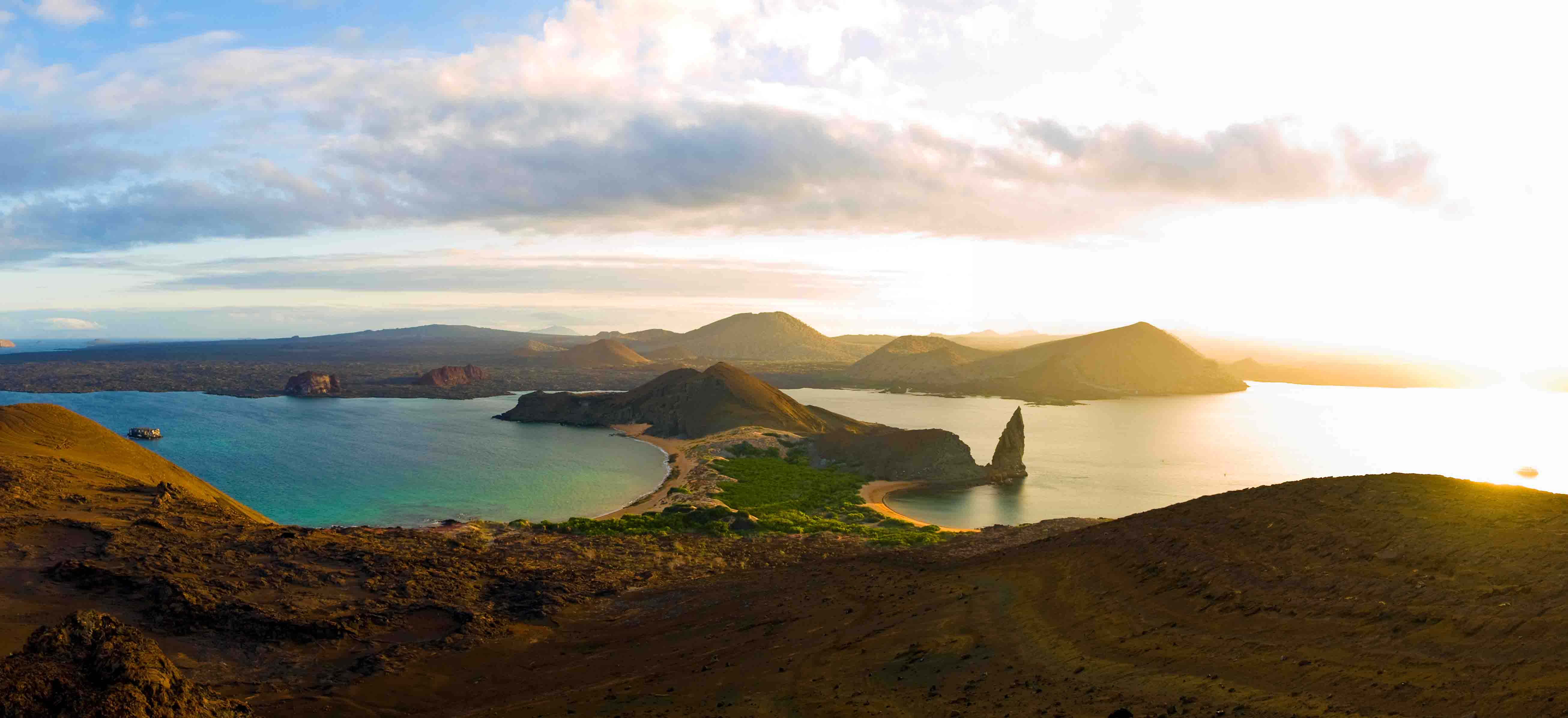
The best known of the island's features is the Tuff Cone known as Pinnacle Rock. This large black partially eroded lava formation was created when magma expelled from the volcano reached the sea. When the seawaters cooled the hot lava it caused an explosion. The exploded particles eventually  fasten together forming a rock composed of thin layers.

Bartolome's Pinnacle Rock has become one of the best recognized and most photographed  sights in the islands. A prominent sight it was used as a target for US airmen during WWII. Lying beside the Pinnacle Rock are twin half moon shaped beaches.

The northern beach is a popular snorkeling site where visitors have the opportunity to swim with fish, Sea Lions and Galapagos Penguins. Much larger animals can be found near the southern beach including stingrays, spotted eagle rays, white-tipped sharks, and black-tipped sharks.

Little vegetation grows in this barren place. Mangroves border the beach and the small shrub Tiguilia grows in the volcanic sands. The seeds and tiny white flowers of the Chamaesycae provide food for the island's finch. These plants are common to arid regions and are able to survive in these harsh volcanic conditions.

Seasonally Bartolome is the mating and nesting site for the Green Sea Turtles. Very little was once known of these enchanting creatures of the sea. They lived secretive lives only surfacing to breathe. In recent years, sea turtles have been the subjects of a variety of international studies.

The Pacific Green Sea Turtle frequents the Galapagos Islands mating in the waters and laying eggs in the sands of the beaches. Green Sea Turtles do not mate for life or form bonds with their mates. Both the males and females of the species have many partners each season. Peak mating occurs between November and January.

Females come ashore at night during high tide to lay more than 80 eggs at a time. The female may lay eggs 8 times per season. The female comes ashore and digs a pit with her flippers near the high water mark. After laying the eggs she covers them with sand before returning to the sea. The process takes 3 to 4 hours.

The temperature of the incubation determines the sex of the young turtles. Eggs incubated at 82ºF will be males and those incubated at 90ºF will become females. The eggs hatch in approximately 2 months. Very few of the hatchlings survive their first year of life. Eggs are vulnerable to pigs and goats, as well as the natural predator the Trox Suberosus Beetle. Sea Birds prey on the young turtles making their way from their nests to the sea. Once in the water Orcas, Sharks and Crabs feed on the turtles. With the high mortality rate and disappearing nesting grounds around the world Green Sea Turtles are now an endangered species and the Galapagos breeding grounds is an important area for the preservation of these creatures.


View of Pinnacle Rock and Bay from the Summit of Bartolome

Visits on Bartolome

Located off the eastern shore of Santiago Island a visit begins with a dry landing. Once ashore, the Summit Trail begins with a rock and concrete pathway. The walk continues through volcanic sand, which can be slow to cross. Once through the sand the steep ascent continues up a wooden stairway. From landing to top the walk takes approximately 30 to 40 minutes.
 

The volcanic landscape on the journey up seems barren except for the Lava Lizards scurrying about. Further up volcanic spatter cones with deep red, gleaming blacks and intense greens can be seen on both sides of the trail. The Spatter Cones and Lava Tubes give the feeling that you are hiking on the moon rather than an island in the Pacific.
Arriving at the top you are treated to one of the great panoramic views in the Galapagos. To the distance the islands of Santiago, Santa Cruz, Baltra, North Seymour, Rabida as well as a number of rocks and small inlets can be seen. The islands vary in color from a bright orange, to blacks and greens. The turquoise waters and white shores add to the incredible seen. The eroded pinnacle rock stands at the end of the island poising for pictures.


It's easy to see why this is one of the most popular photographic spots in all the islands.

Landing:  Dry Landing
Highlights: View of Pinnacle Rock, Excellent Photographic Opportunity.
Conditions: Steep Trail with wooden steps
Notes: Bring water, good hiking shoes and a windbreaker. Take your time going up the steps. The view is well worth the walk.


A short panga ride takes visitors to Bartolome's Double- Sided Beach. A short walk to the south beach leads through mangroves and past dune vegetation. Mating Sea Turtles are frequently seen as are white-tipped sharks, rays, blue herons. Returning to the north beach offers excellent swimming and snorkeling opportunities. Galapagos Penguins are frequently seen swimming in these waters.

Landing: Wet Landing
Highlights: Mating Sea Turtles, Rays and White-Tipped Sharks and Penguins
Conditions: Easy walk and good snorkeling
Notes: One of the best areas to get photos of Galapagos Penguins.


c 1999-2008 Galapagos Online Tours.  All rights reserved
