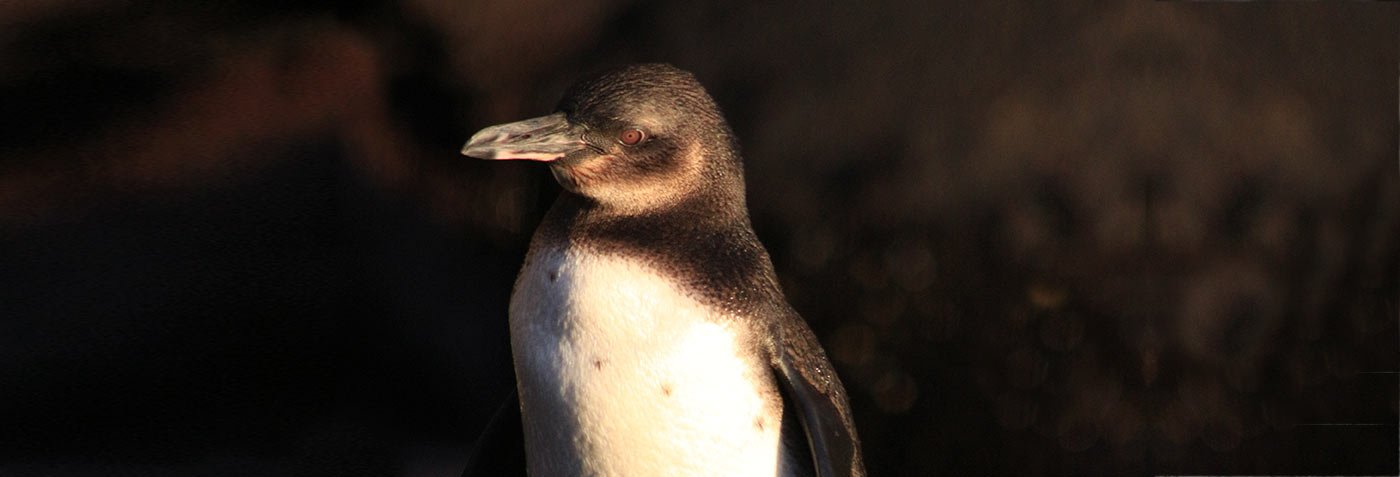
Listing and habits of the land birds that inhabit the Enchanted Islands
Few species of land birds inhabit the Galapagos Islands, and Galapagos Yellow Birdthree-quarters of these are endemic or occurring Only In The Archipelago. Unlike the Seabirds, most of which are excellent long-distance fliers, land birds from the tropics have little cause to make long flights. Though relatives of all the Galápagos species may be found on the nearby mainland, only a freak of fate would bring them out a thousand kilometers from land. This must have happened, however, at least fourteen times in the past.
With few exceptions, the land birds are a singularly dull-colored lot. As if to make up for this lack of exciting color, their “tameness” is unsurpassed. With attitudes to humans that seem to range from indifference, through curiosity and fearlessness, to outright impudence, the Galapagos land birds are a pleasure to watch and study.
Because Galapagos visitors spend so much time on and around the water, the sea and shore birds typically Galapagos Islands Bird receive more attention than the land birds. The seabirds tend to be bigger, more obvious, can be observed more easily, and display lots of different types of behaviors. Land birds, on the other hand, are smaller, drabber, and more secretive. It takes more effort, more patience, and more understanding to observe them. Some birds, like the cuckoo and the rail, have small populations and tend to be cryptic in their habits. There are 29 recognized species of land birds living in the Galapagos Islands and Darwin came close to seeing them all. Of course, he didn’t visit all of the islands and didn’t see everything. Darwin succinctly cataloged the resident land birds in the “Voyage of the Beagle”:
“Of land-birds I obtained twenty-six kinds, all peculiar to the group and found nowhere else, with the exception of one lark-like finch from North America (Dolichonyx oryzivorous*), which ranges on that continent as far north as 54 degrees and generally frequents marshes. The other twenty-five birds consist, firstly, of a hawk, curiously intermediate in structure between a Buzzard and the American group of carrion-feeding Polybori; and with this latter, it agrees most closely in every habit and even tone of voice. Secondly, there are two owls, representing the short-eared and barn owls of Europe. Thirdly, a wren, three tyrant-flycatchers (two of them species of Pyrocephalus, one or both of which would be ranked by some ornithologists as only varieties), and a dove — all analogous to but distinct from, American species. fourthly, a swallow, which though differing from the Progene purpurea of both Americas, only in being rather duller colored, smaller, and slenderer, is considered by Mr. Gould as specifically distinct. Fifthly, there are three species of mocking-thrush — a form highly characteristic of America. The remaining land-birds form a most singular group of finches, related to each other in the structure of their beaks, short tails, the form of the body, and plumage. There are thirteen species, which Mr. Gould has divided into four sub-groups. All these species are peculiar to this archipelago.…”
Charles Darwin, 1845